<?xml version="1.0" encoding="utf-8"?><feed xmlns="http://www.w3.org/2005/Atom" ><generator uri="https://jekyllrb.com/" version="3.10.0">Jekyll</generator><link href="https://breeznik.github.io/blogs/feed.xml" rel="self" type="application/atom+xml" /><link href="https://breeznik.github.io/blogs/" rel="alternate" type="text/html" /><updated>2026-03-01T18:59:08+00:00</updated><id>https://breeznik.github.io/blogs/feed.xml</id><title type="html">Breeznik</title><subtitle>Things I read, watched, or thought about — written down.</subtitle><author><name>Nikhil Rao</name></author><entry><title type="html">From Idea to Impact</title><link href="https://breeznik.github.io/blogs/building-brands-inka-session/" rel="alternate" type="text/html" title="From Idea to Impact" /><published>2026-03-01T00:00:00+00:00</published><updated>2026-03-01T00:00:00+00:00</updated><id>https://breeznik.github.io/blogs/building-brands-inka-session</id><content type="html" xml:base="https://breeznik.github.io/blogs/building-brands-inka-session/"><![CDATA[<p><em>A founder conversation with Vaibhav (Inka), hosted by Questing Minds and Entrepreneurs Cafe.</em></p>

<p>Some sessions give you motivation. This one gave people language for decisions they have been struggling with for years: when to leave home, how to handle money in your 20s, what “selling” really means, and why brand values are not a poster on the wall but a set of choices you repeat when it is inconvenient.</p>

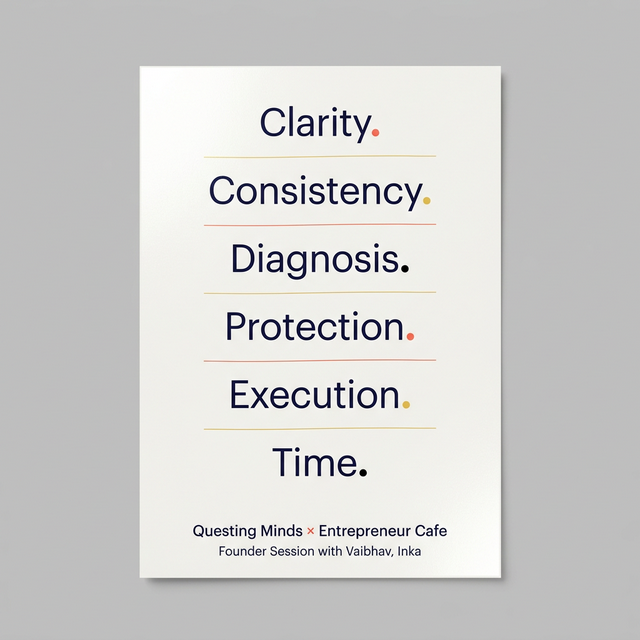
<p><img src="/blogs/assets/posts/building-brands-inka-session/01-hero.png" width="100%" alt="Questing Minds and Entrepreneurs Cafe — Founder Session with Vaibhav, Inka" /></p>

<nav class="toc">
<p class="toc-title">Contents</p>
<ol>
  <li><a href="#quick-read">Quick read: what you will take away</a></li>
  <li><a href="#about-the-guest">About the guest</a></li>
  <li><a href="#the-story">The story arc: from comfortable to capable</a></li>
  <li><a href="#playbook">The playbook: 8 lessons worth keeping</a></li>
  <li><a href="#frameworks">Frameworks worth stealing</a></li>
  <li><a href="#mistakes">Mistakes to avoid</a></li>
  <li><a href="#closing">Closing thoughts</a></li>
</ol>
</nav>

<hr />

<h2 id="quick-read">Quick read: what you will take away</h2>

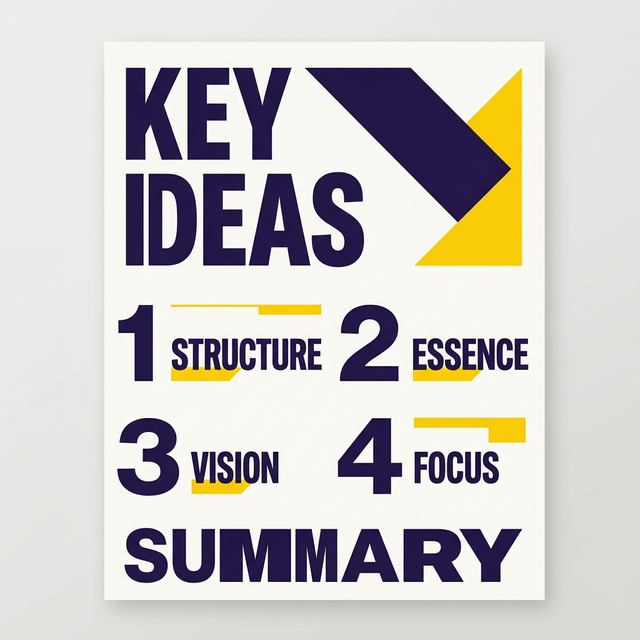
<p><img src="/blogs/assets/posts/building-brands-inka-session/02-takeaways.png" width="100%" alt="7 key takeaways from the session" /></p>

<ul>
  <li>Why moving to a high-pressure professional city early can upgrade your operating system</li>
  <li>How lifestyle inflation silently kills compounding</li>
  <li>A simple way to sell without sounding salesy: start with the need</li>
  <li>Why brand trust is built through consistent trade-offs, not marketing</li>
  <li>A team incentive twist that prevents customer abandonment</li>
  <li>How Tier-2 cities give founders a real edge: time, focus, and cost</li>
  <li>The fundraising reality check: execution beats ideas, early cheques come from trust</li>
</ul>

<p><span class="recap">Seven ideas, each one the kind of thing you wish someone had told you at 22.</span></p>

<hr />

<h2 id="about-the-guest">About the guest</h2>

<p>Vaibhav has spent over two decades across India’s financial and insurance space, with leadership roles at HDFC Life, DBS, Macquarie, and ICICI Prudential. He also co-founded Mahila Money and now leads Inka. The session blended operator experience with founder honesty, which is why it hit differently.</p>

<hr />

<h2 id="the-story">The story arc: from comfortable to capable</h2>

<p>Vaibhav shared that, post MBA, he was content getting a job in Jodhpur. It made sense. It was familiar. It was safe.</p>

<p>Then came a push that changed the trajectory: move to Bombay and learn how the corporate world actually works. He described Bombay as a place that forces exposure, pace, and professionalism. In his words, “If you want to learn business, that’s the only city you need to spend time in.”</p>

<p>Years later, the seed for Inka did not come from a fancy pitch deck moment. It came from something painfully normal: a school WhatsApp group argument about mis-sold insurance.</p>

<p>Instead of treating it like noise, he treated it like signal. He listened. He met people. He asked what exactly went wrong. He noticed a pattern: insurance is rigid, technical, and intimidating for regular users, especially in moments when they need clarity the most.</p>

<p>That is where the startup direction sharpened: build something that owns the customer journey and reduces friction.</p>

<p><span class="recap">The best startup ideas are not invented. They are noticed. Vaibhav found his in a WhatsApp argument.</span></p>

<hr />

<h2 id="playbook">The playbook: 8 lessons worth keeping</h2>

<h3 id="1-growth-requires-a-new-environment-not-just-new-intentions">1. Growth requires a new environment, not just new intentions</h3>

<p>If you stay in the same environment, you often keep the same thinking loops. Vaibhav’s point about moving early was not “metros are superior.” It was about what a high-exposure environment does to your standards.</p>

<p>You learn what “good” looks like faster. You see how decisions get made. You get corrected quickly. That feedback loop is a cheat code.</p>

<p>If you are in your 20s and debating whether to try the bigger city once, this was your nudge: comfort is expensive.</p>

<h3 id="2-your-20s-can-either-buy-you-status-or-buy-you-freedom">2. Your 20s can either buy you status or buy you freedom</h3>

<p>The personal finance part of the session was blunt, and that bluntness was useful.</p>

<p>He spoke about the trap of gadget upgrades, luxury spends, and credit-card living. It looks harmless because it is normalised. But the cost is not the phone or the shoes. The cost is the years of compounding you lose.</p>

<p>He gave a memorable image: “living a Bruce Wayne lifestyle without Bruce Wayne’s money.” Funny line, serious point.</p>

<p>The underlying message was simple: spend, but do not let spending become your identity. Save early, invest early, and let time do what effort cannot.</p>

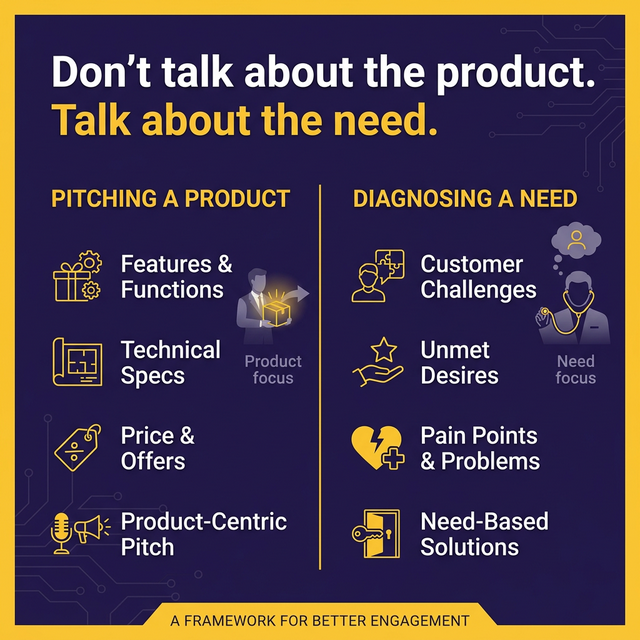
<h3 id="3-selling-is-not-persuasion-selling-is-diagnosis">3. Selling is not persuasion. Selling is diagnosis.</h3>

<p><img src="/blogs/assets/posts/building-brands-inka-session/03-sales.png" width="100%" alt="The sales reframe: start with the need, not the product" /></p>

<p>This was one of the strongest segments, because it reframes sales for founders who hate “sales.”</p>

<p>Vaibhav kept coming back to a principle: “Don’t talk about the product. Talk about the need.”</p>

<p>The famous “sell me this pen” question is usually answered with features. He argued that features are the last step, not the first. Start with questions: who are you, what do you do every day, what problem are you solving right now, why does it matter?</p>

<p>A teacher buying a pen and a doctor buying a pen are buying different outcomes. Once you understand the outcome, you only need two or three features that connect directly to that need.</p>

<p>If your pitch feels like people are not listening, it is often because you are talking about your product before you have earned the right to.</p>

<p><span class="recap">Features are the last step. The first step is understanding what outcome the person is actually buying.</span></p>

<h3 id="4-brand-is-a-set-of-decisions-you-do-not-reverse">4. Brand is a set of decisions you do not reverse</h3>

<p>He described brand as something you protect like a core value, not something you “market into existence.”</p>

<p>He used the Alphabet vs Meta comparison to show how deeply a company’s philosophy shapes everything it does. One lane prioritises user trust and long-term utility. Another prioritises aggressive monetisation and investor returns.</p>

<p>His point was not that one is good and the other is bad. His point was that you cannot switch lanes based on mood. Brand trust is built when people can predict your behaviour even when money tempts you.</p>

<p>He put it simply: “Brand is your baby.” If you compromise it for short-term gains, you might get revenue today and lose trust tomorrow.</p>

<h3 id="5-culture-is-not-a-slogan-it-is-what-happens-when-nobody-is-watching">5. Culture is not a slogan. It is what happens when nobody is watching.</h3>

<p>“Culture eats strategy for breakfast” came up for a reason. Strategy can be rewritten. Culture shows up every single day in small decisions, especially in hiring.</p>

<p>One practical hiring insight from the session: attitude beats raw intellect if the intellect comes with toxicity.</p>

<p>A toxic high performer can demotivate an entire team. A healthy team can coach up skill gaps. This is a hard lesson most founders learn late, usually after one bad hire creates a long recovery period.</p>

<h3 id="6-design-incentives-to-protect-the-customer-not-the-individual">6. Design incentives to protect the customer, not the individual</h3>

<p>One of the most interesting operational choices shared was how the business thinks about incentives.</p>

<p>Instead of a traditional “sales team,” the model uses a Customer Service Team. Individual commissions are replaced with shared targets.</p>

<p>Why? Because individual targets create a predictable failure mode: customers get “owned” by one person, and when that person is absent, the customer gets abandoned. Team-based ownership protects continuity, reduces internal competition, and keeps the service experience stable.</p>

<p>Design incentives so the customer never pays for internal politics.</p>

<h3 id="7-the-tier-2-advantage-is-real-and-mostly-invisible">7. The Tier-2 advantage is real, and mostly invisible</h3>

<p><img src="/blogs/assets/posts/building-brands-inka-session/04-tier2.png" width="100%" alt="The Tier-2 founder advantage: time, cost, and focus" /></p>

<p>This part was especially relevant for the community in the room.</p>

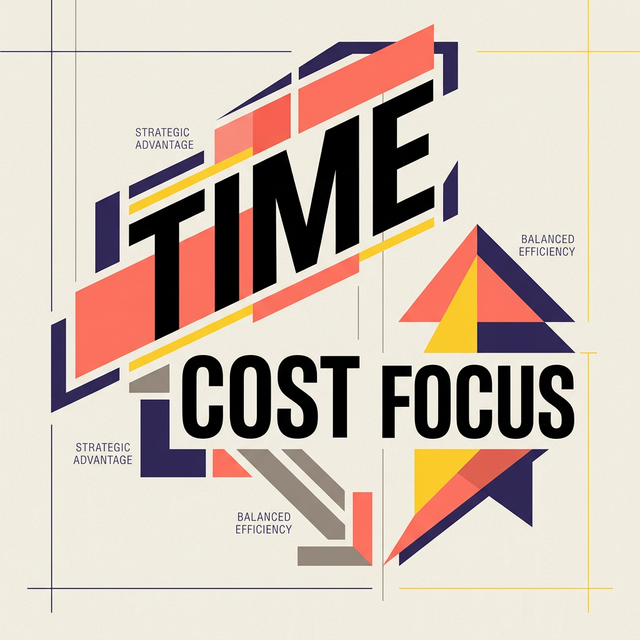
<p>Vaibhav made a simple claim: building from Tier-2 cities gives you time, and time is the most important currency.</p>

<p>Less commute. Lower rent. Lower burn. More focus. More runway for experiments.</p>

<p>He even called out metro office rents as a constant pressure that forces rushed decisions. In a Tier-2 setup, you can afford to think, test, and iterate without panic.</p>

<p>Post-COVID remote pitching also changes the game. Investors are more open to online meetings, which reduces the disadvantage that used to come from geography.</p>

<p>If you are building from a Tier-2 city, your job is not to apologise for it. Your job is to use the advantage properly.</p>

<p><span class="recap">Time, cost, and focus. Tier-2 cities give you all three. The only thing you need to add is ambition.</span></p>

<h3 id="8-fundraising-reality-investors-back-founders-not-ideas">8. Fundraising reality: investors back founders, not ideas</h3>

<p>This is where the room usually gets quiet.</p>

<p>Vaibhav’s line was sharp: “Ideas are 8 billion in population. Execution is the difference.”</p>

<p>Ideas are cheap because everyone has them. Execution is rare because it requires consistency, resilience, and speed of learning.</p>

<p>He also said something many early founders underestimate: your first cheques usually come from people who know you, or people who trust your track record.</p>

<p>So if you are preparing for fundraising, focus on two things: show proof that you can execute, and build trust before you need money.</p>

<hr />

<h2 id="frameworks">Frameworks worth stealing</h2>

<p><strong>Dual goal-setting</strong></p>

<p>Have two goals running in parallel: a specific 5 to 7-year goal (something tangible) and a broader 15-year aspiration (your bigger identity arc). The tangible goal keeps you grounded and disciplined. The long vision keeps you inspired when the short-term gets messy.</p>

<p><strong>A simple way to think about product-market fit</strong></p>

<p>Vaibhav described PMF like an input-output relationship. If increasing your input (marketing, distribution effort) increases your output proportionally (traction, revenue), you are seeing early signs of fit. If doubling input does not change output, you do not have PMF. You have noise.</p>

<p><strong>Founder-market fit comes before product-market fit</strong></p>

<p>Before you chase PMF, ask if you have founder-market fit: deep industry understanding, insider edge, or a unique advantage. If you do not, your learning curve becomes your biggest competitor.</p>

<p><span class="recap">PMF is not a feeling. It is a ratio. Input goes up, output goes up. If it does not, keep searching.</span></p>

<hr />

<h2 id="mistakes">Mistakes to avoid</h2>

<ol>
  <li>Treating lifestyle upgrades as progress</li>
  <li>Using credit cards to fund an identity you cannot afford</li>
  <li>Delaying investing and missing compounding years</li>
  <li>Under-insuring yourself because “nothing will happen”</li>
  <li>Hiring a toxic top performer and calling it high standards</li>
  <li>Building a business where you never own the customer lifecycle</li>
</ol>

<hr />

<h2 id="closing">Closing thoughts</h2>

<p>This conversation did not glorify hustle. It glorified clarity.</p>

<p>Clarity about money. Clarity about values. Clarity about what customers actually need. Clarity about culture. Clarity about execution.</p>

<p>The biggest theme was consistency: your career, your brand, and your company become what you repeat.</p>

<p><img src="/blogs/assets/posts/building-brands-inka-session/05-closing.png" width="100%" alt="Clarity, consistency, execution — what the session was really about" /></p>

<h3 id="discussion-prompts-for-the-community">Discussion prompts for the community</h3>

<ol>
  <li>What is one money habit you wish you started at 22?</li>
  <li>When you sell, do you start with the need or the features?</li>
  <li>If you are building from a Tier-2 city, what is your biggest advantage right now: time, cost, or focus?</li>
</ol>

<hr />

<details style="margin-top: 2rem; border-top: 1px solid var(--border); padding-top: 2rem;">
<summary style="cursor: pointer; color: var(--text-muted); font-size: 0.8rem; text-transform: uppercase; letter-spacing: 0.12em; list-style: none; -webkit-appearance: none; user-select: none;">About the people behind this session &darr;</summary>
<div style="color: var(--text-muted); font-size: 0.875rem; line-height: 1.8; margin-top: 1.5rem;">

<p><strong style="color: var(--text-muted); text-transform: uppercase; letter-spacing: 0.08em; font-size: 0.78rem;">Questing Minds</strong><br />
A community for people in their 20s, based in Jodhpur and founded by Chirag Mirchandani. Since launching, Questing Minds has hosted 20+ meetups for 80+ curious minds from all sorts of backgrounds — students, working professionals, early founders, and people still figuring it out. The mission: a creative, collaborative space where it is okay to mess up, as long as you learn and grow. Tagline: "Keep curiosity alive!"<br />
<a href="https://www.instagram.com/questing_minds" style="color: var(--text-muted);">Instagram</a> &middot; <a href="https://www.linkedin.com/in/chirag-mirchandani-1b73801ab/" style="color: var(--text-muted);">Chirag on LinkedIn</a></p>

<p><strong style="color: var(--text-muted); text-transform: uppercase; letter-spacing: 0.08em; font-size: 0.78rem;">Entrepreneur Cafe</strong><br />
A global community-led platform for founders, entrepreneurs, and innovators. Registered as a non-profit in India, Entrepreneur Cafe runs pitch-free events where founders share honest, unscripted experiences — no sales pressure, no scripts. Chapters are run by appointed City Mayors across cities worldwide. The Jodhpur chapter is led by Deepesh Dhariwal. Tagline: "let's discuss ideas."<br />
<a href="https://www.entrepreneurcafe.org" style="color: var(--text-muted);">Website</a> &middot; <a href="https://in.linkedin.com/company/entrepreneur-cafe" style="color: var(--text-muted);">LinkedIn</a> &middot; <a href="https://www.linkedin.com/in/deepesh-dhariwal/" style="color: var(--text-muted);">Deepesh on LinkedIn</a></p>

<p><strong style="color: var(--text-muted); text-transform: uppercase; letter-spacing: 0.08em; font-size: 0.78rem;">Inka</strong><br />
India's personalised insurance platform, founded by Vaibhav Kathju, Abhay Singh, and Gaurav Gupta. Formerly InsurancePadosi, rebranded as Inka in March 2025. The Inka Insurance Report asks simple questions about your life and delivers a personalised insurance blueprint in under a minute. 75,000+ registered users across 12,000+ pin codes.<br />
<a href="https://www.instagram.com/inka.insurance/" style="color: var(--text-muted);">Instagram</a> &middot; <a href="https://in.linkedin.com/company/inkainsurance" style="color: var(--text-muted);">LinkedIn</a> &middot; <a href="https://in.linkedin.com/in/kathju" style="color: var(--text-muted);">Vaibhav on LinkedIn</a> &middot; <a href="https://x.com/Kathju13" style="color: var(--text-muted);">X</a></p>

</div>
</details>]]></content><author><name>Nikhil Rao</name></author><category term="startups" /><category term="entrepreneurship" /><category term="sales" /><category term="brand" /><category term="founder" /><category term="personal-finance" /><summary type="html"><![CDATA[A founder conversation on entrepreneurship, fundraising, branding, and what it actually takes to build something real. Hosted by Questing Minds and Entrepreneurs Cafe.]]></summary><media:thumbnail xmlns:media="http://search.yahoo.com/mrss/" url="https://breeznik.github.io/blogs/assets/posts/building-brands-inka-session/01-hero.png" /><media:content medium="image" url="https://breeznik.github.io/blogs/assets/posts/building-brands-inka-session/01-hero.png" xmlns:media="http://search.yahoo.com/mrss/" /></entry><entry><title type="html">The World Is on Fire: What’s Actually Happening Right Now</title><link href="https://breeznik.github.io/blogs/geopolitical-world-report-march2026/" rel="alternate" type="text/html" title="The World Is on Fire: What’s Actually Happening Right Now" /><published>2026-03-01T00:00:00+00:00</published><updated>2026-03-01T00:00:00+00:00</updated><id>https://breeznik.github.io/blogs/geopolitical-world-report</id><content type="html" xml:base="https://breeznik.github.io/blogs/geopolitical-world-report-march2026/"><![CDATA[<p align="center">
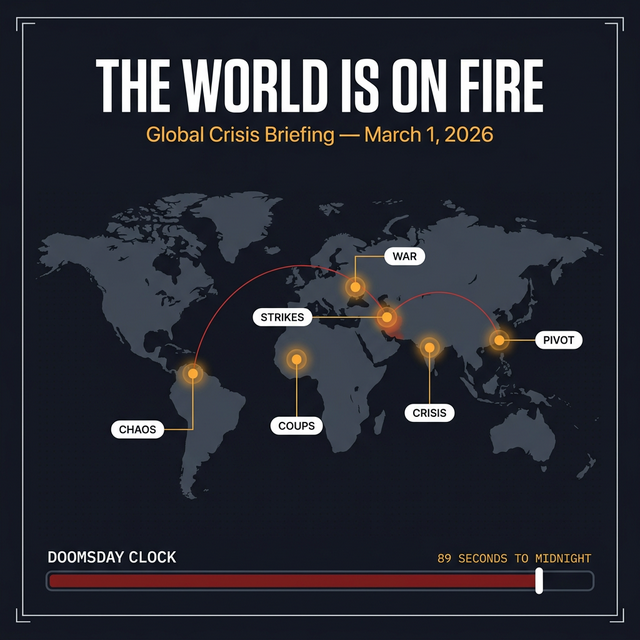
  <img src="/blogs/assets/posts/geopolitical-world-report-march2026/01-hero.png" width="100%" alt="World in Crisis, March 2026" />
</p>

<p><em>You don’t need to follow the news every day to read this. Everything is explained from the ground up. Share it with anyone who wants to understand what’s actually happening in the world.</em></p>

<hr />

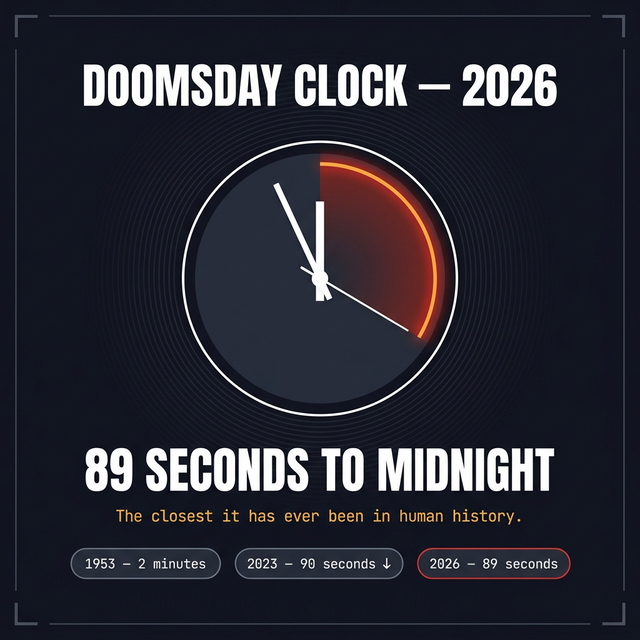
<p>There is a clock. The Bulletin of Atomic Scientists moves it every year. They call it the Doomsday Clock, and they set it based on how close humanity is to destroying itself: through nuclear weapons, climate collapse, or catastrophic technology.</p>

<p>As of March 2026, that clock sits at <strong>89 seconds to midnight</strong>.</p>

<p>The closest it has ever been. In all of human history.</p>

<p align="center">
  <img src="/blogs/assets/posts/geopolitical-world-report-march2026/02-doomsday-clock.png" width="75%" alt="Doomsday Clock: 89 Seconds to Midnight, March 2026" />
</p>

<p>This is not a metaphor. This is where we are.</p>

<hr />

<nav class="toc">
  <p><span class="toc-label">Contents · 20 min read</span></p>

  <ol>
    <li><a href="#part-1">The World Order Is Cracking</a></li>
    <li><a href="#part-2">The Iran Strike, February 28, 2026</a></li>
    <li><a href="#part-3">What Happens Inside Iran Now?</a></li>
    <li><a href="#part-4">Russia and Ukraine: Four Years, No End</a></li>
    <li><a href="#part-5">Israel and Gaza: A Ceasefire That Barely Breathes</a></li>
    <li><a href="#part-6">US vs China: The Cold War Nobody Named</a></li>
    <li><a href="#part-7">The Wars Nobody Is Talking About</a></li>
    <li><a href="#part-8">The Nuclear Danger</a></li>
    <li><a href="#part-9">Your Wallet in a World at War</a></li>
    <li><a href="#part-10">What Could Get Worse, and How</a></li>
    <li><a href="#part-11">India: The Country Everyone Needs</a></li>
    <li><a href="#part-12">What Happens Next</a></li>
  </ol>

</nav>

<hr />

<h2 id="part-1">Part 1: The World Order Is Cracking</h2>

<p>For eighty years after World War 2 ended in 1945, the world ran on a set of agreed rules. Countries don’t invade other countries without consequences. Nuclear powers don’t go to war with each other. The United Nations mediates disputes. Trade flows freely. The US dollar anchors the global economy.</p>

<p>These rules were never perfect. But they held, mostly.</p>

<p>In 2026, almost every single one of those rules is under simultaneous stress.</p>

<p>Russia invaded Ukraine and has been grinding forward for four years. The United States launched military strikes in Venezuela and Iran within six weeks of each other. China is simulating full blockades of Taiwan. North Korea is building submarine-launched nuclear missiles. The last nuclear arms treaty between the US and Russia expired in February 2026, leaving no guardrails for the first time in fifty years.</p>

<p>This is not one crisis. It is many crises happening at once, feeding into each other.</p>

<p><span class="recap">The 80-year rules-based world order is under simultaneous stress on every front. This isn’t one crisis. It’s all of them at once.</span></p>

<hr />

<h2 id="part-2">Part 2: The Biggest Story on Earth Right Now</h2>

<h3 id="on-february-28-2026-the-united-states-and-israel-struck-iran">On February 28, 2026, the United States and Israel struck Iran.</h3>

<p align="center">
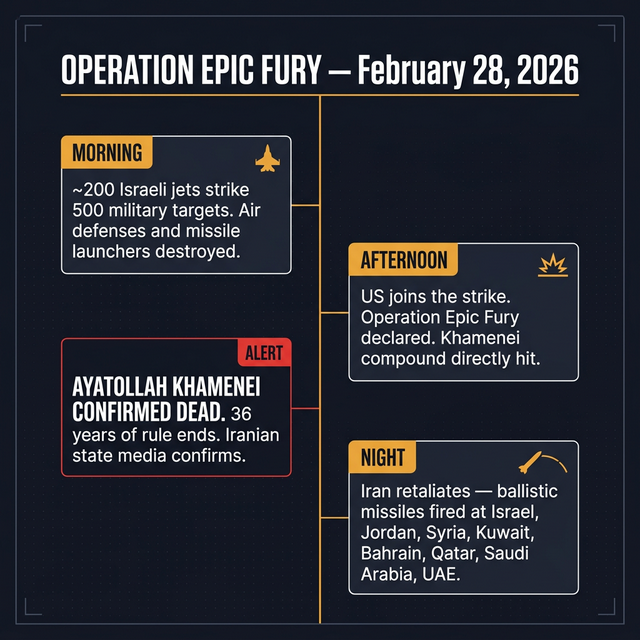
  <img src="/blogs/assets/posts/geopolitical-world-report-march2026/03-iran-strike-timeline.png" width="85%" alt="Operation Epic Fury: Iran Strike Timeline, February 28, 2026" />
</p>

<p>On the morning of February 28, approximately 200 Israeli fighter jets launched strikes on over 500 Iranian military targets: air defense systems, missile launchers, and military bases across western and central Iran. The United States joined the operation, which the Pentagon named <strong>“Operation Epic Fury”</strong> and Israel named <strong>“Operation Roaring Lion.”</strong></p>

<p>By afternoon, US President Donald Trump confirmed what Iranian state media would verify hours later:</p>

<blockquote>
  <p><strong>Ayatollah Ali Khamenei, Iran’s Supreme Leader for 36 years, was dead.</strong></p>
</blockquote>

<p>He was killed in an airstrike on his compound in Tehran. His daughter, grandchild, son-in-law, and daughter-in-law were also killed. Thousands of IRGC personnel were killed or wounded across multiple bases. Over 40 Iranian leaders died in the strikes in total.</p>

<p>Iran retaliated the same night, launching dozens of ballistic missiles at Israel and at US military bases across Jordan, Syria, Kuwait, Bahrain, Qatar, Saudi Arabia, and the United Arab Emirates.</p>

<p>By midnight on February 28, the Middle East had fundamentally changed.</p>

<hr />

<h3 id="why-did-the-us-strike">Why did the US strike?</h3>

<p>The short version: Iran was months away from building a nuclear weapon, and three rounds of diplomacy failed.</p>

<p>Talks in Muscat on February 6 collapsed when the US demanded Iran destroy its nuclear sites at Fordow, Natanz, and Isfahan and hand over its enriched uranium. Iran refused and demanded all sanctions be lifted first. The gap was unbridgeable. Trump called negotiations going nowhere. The strikes came three weeks later.</p>

<hr />

<h3 id="how-did-the-world-react">How did the world react?</h3>

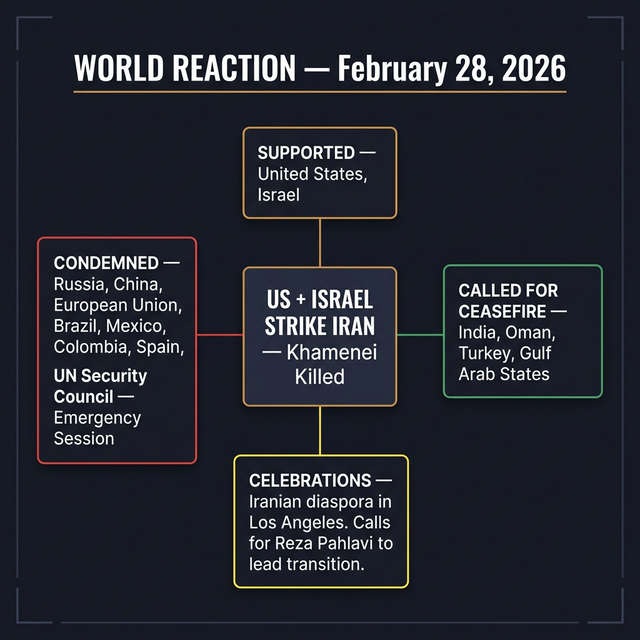
<p align="center">
  <img src="/blogs/assets/posts/geopolitical-world-report-march2026/04-world-reaction.png" width="85%" alt="How the World Reacted to the Iran Strike" />
</p>

<p>The world split almost immediately.</p>

<p><strong>Condemned the strikes:</strong> Russia, China, the European Union, Brazil, Colombia, Mexico, Spain, and the United Nations Security Council, which convened an emergency session.</p>

<p><strong>Called for an immediate ceasefire:</strong> India, Oman (the key mediator in US-Iran talks), Turkey, and Gulf Arab states.</p>

<p><strong>Stayed silent or supported:</strong> Almost no one beyond the US and Israel themselves.</p>

<p>In Los Angeles, crowds of Iranian diaspora erupted in celebration. Calls began circulating for Reza Pahlavi, son of the former Shah, to return to Iran as a transitional leader.</p>

<p><span class="recap">The US-Israel strike killed Khamenei and dismantled Iran’s defenses overnight. The Middle East will not return to what it was before February 28, 2026.</span></p>

<hr />

<h2 id="part-3">Part 3: What Happens Inside Iran Now?</h2>

<p>This is the question that determines everything.</p>

<p align="center">
  <img src="/blogs/assets/posts/geopolitical-world-report-march2026/05-iran-futures.png" width="85%" alt="Iran's Four Possible Futures After Khamenei" />
</p>

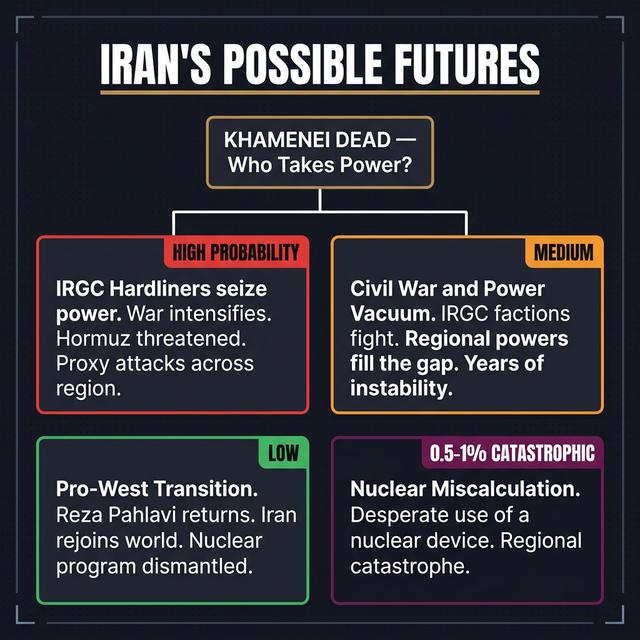
<p>Khamenei ruled Iran for 36 years. No successor was officially named. Iran’s constitution says the Assembly of Experts must appoint a new Supreme Leader, but the body that actually holds power in any transition is the <strong>IRGC</strong>, the Islamic Revolutionary Guard Corps. Iran’s most powerful military and political force. It controls the missile program, the nuclear program, and vast sections of the Iranian economy.</p>

<p>The CIA assessed before the strikes that if Khamenei were killed, hardline IRGC figures, not reformers, would most likely take control.</p>

<p>Four scenarios are possible:</p>

<p><strong>The most likely:</strong> IRGC hardliners seize power, the war intensifies, Iran threatens to close the Strait of Hormuz, and proxy forces including Hezbollah, Houthis, and Iraqi militias, launching coordinated attacks across the region. The Middle East war expands.</p>

<p><strong>The second possibility:</strong> Iran collapses into a civil war. IRGC factions fight each other. Saudi Arabia, Turkey, and the UAE fill the vacuum. Years of instability follow, producing a refugee crisis and a regional power struggle.</p>

<p><strong>The hoped-for but unlikely scenario:</strong> Reform figures take over. Reza Pahlavi returns. Iran rejoins the international community. The nuclear program is dismantled. Over years, an Iran-Israel normalization becomes possible.</p>

<p><strong>The catastrophic but low-probability scenario:</strong> AI models estimate a 0.5% to 1% probability that desperate IRGC elements attempt nuclear use. That probability sounds small. With 8 billion people on Earth, it is not a number to dismiss.</p>

<p><span class="recap">Iran’s most likely path is IRGC hardliners seizing control. The conflict is just beginning, not ending.</span></p>

<hr />

<h2 id="part-4">Part 4: Russia and Ukraine: Four Years, No End</h2>

<p align="center">
  <img src="/blogs/assets/posts/geopolitical-world-report-march2026/06-russia-ukraine.png" width="85%" alt="Russia-Ukraine War: 4 Years In" />
</p>

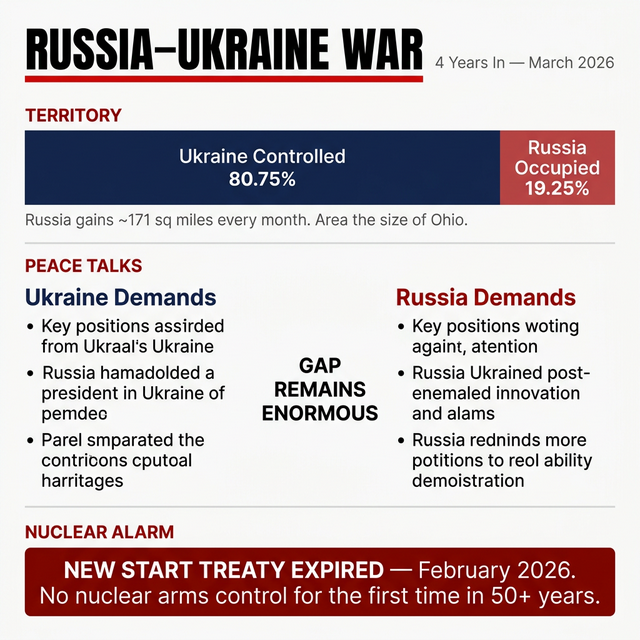
<p>Russia invaded Ukraine on February 24, 2022. That was four years ago.</p>

<p>Russia currently occupies approximately <strong>19.25% of Ukrainian territory</strong> (roughly the size of Ohio), gaining about <strong>171 square miles per month</strong> through grinding attrition warfare.</p>

<p>Peace talks are active but stuck. US envoys Steve Witkoff and Jared Kushner have been brokering negotiations in Abu Dhabi and Geneva. Ukrainian President Zelenskyy says “90% of a potential deal is agreed.” But the remaining 10% is everything. Russia wants to keep Donbas permanently and wants a guarantee Ukraine never joins NATO. Ukraine refuses to cede territory or sovereignty.</p>

<p>Since Trump took office, Europe has replaced most US military and financial support for Ukraine; the EU now accounts for nearly <strong>90% of financial flows</strong> to Kyiv. The UK and France have pledged to deploy troops to Ukrainian territory if a ceasefire is reached.</p>

<p>There is a danger nobody is talking about loudly enough.</p>

<blockquote>
  <p><strong>In February 2026, the New START treaty expired. It was the last nuclear arms control agreement between the United States and Russia.</strong></p>
</blockquote>

<p>For the first time in over fifty years, there are no limits on how many nuclear weapons either country can build, no verification inspections, and no communication protocols. Both sides are flying without a safety net.</p>

<p><span class="recap">The Ukraine war grinds forward with no ceasefire, no nuclear guardrails, and no end in sight.</span></p>

<hr />

<h2 id="part-5">Part 5: Israel and Gaza: A Ceasefire That Barely Breathes</h2>

<p>To understand March 2026, you need to understand how the Middle East got here. It started not with Iran, but with a music festival in southern Israel.</p>

<p>On October 7, 2023, Hamas launched a surprise attack on Israel, killing approximately 1,200 Israelis and taking 250 hostage. Israel launched a full ground war in Gaza in response. Then Hezbollah escalated on the northern border. Then Iran fired missiles directly at Israel for the first time in history. Then Assad’s regime collapsed in Syria in late 2024, ending 54 years of Assad family rule in a matter of days. Then Houthi forces in Yemen began attacking commercial shipping in the Red Sea, disrupting global trade routes.</p>

<p>It is one chain of events stretching across two years.</p>

<p>A US-brokered ceasefire in Gaza was signed on October 10, 2025. It is barely holding.</p>

<p>Since the ceasefire: <strong>over 450 Gazans have been killed.</strong> Israel controls more than half of the Gaza enclave. Hundreds of thousands of people remain displaced in makeshift tents without reliable access to water, electricity, or healthcare.</p>

<p>On March 1, 2026, Israel banned <strong>37 humanitarian agencies</strong> from operating in Gaza.</p>

<p>Israel has also drawn up contingency plans for a new ground offensive if Hamas does not disarm. Whether the Iran crisis accelerates or delays that decision remains to be seen.</p>

<p><span class="recap">A fragile ceasefire, an ongoing humanitarian catastrophe, and a possible Israeli ground offensive still sitting on the table.</span></p>

<hr />

<h2 id="part-6">Part 6: The US and China: The Cold War Nobody Named</h2>

<p align="center">
  <img src="/blogs/assets/posts/geopolitical-world-report-march2026/08-us-china.png" width="85%" alt="US vs China: Cold War 2.0" />
</p>

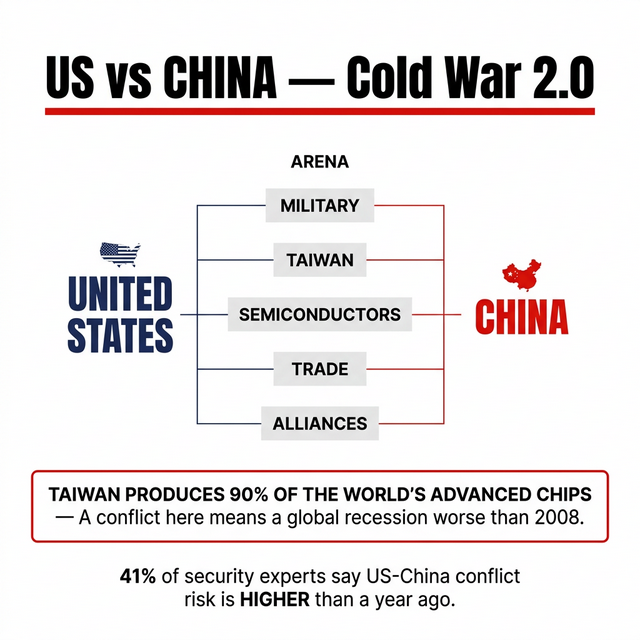
<p>Every conflict on this list exists in the shadow of the US-China competition. It is the background music of global politics in 2026, with a flashpoint that could trigger the most catastrophic war in human history.</p>

<p>That flashpoint is <strong>Taiwan</strong>.</p>

<p>Taiwan produces approximately <strong>90% of the world’s most advanced semiconductors</strong>, the chips inside every smartphone, every modern car, every AI system, every advanced weapons platform. A conflict over Taiwan would not be a regional crisis. It would collapse the global technology supply chain. Economic models estimate a Taiwan war would cost China <strong>8.9% of its GDP</strong> in the first year, the United States <strong>3.2%</strong>, and the world <strong>5.3%</strong>, worse than the 2008 financial crisis.</p>

<p>On December 29 and 30, 2025, China conducted its largest military exercises since 2022, named “Justice Mission 2025.” For the first time in years, China fired long-range projectiles directly into the Taiwan Strait. The simulation modeled a complete blockade of the island.</p>

<p>The US responded by approving an <strong>$11 billion arms package</strong> for Taiwan and signing a bilateral trade deal capping US tariffs on Taiwanese goods.</p>

<p><strong>41% of leading security experts</strong> surveyed by the Center for Strategic and International Studies say the risk of US-China military conflict is higher now than it was a year ago. China is approaching its 2027 military readiness goal, the year analysts have long watched as a potential window for action on Taiwan.</p>

<p><span class="recap">Taiwan is the most consequential flashpoint on Earth. 2027 is the year the whole world should be watching.</span></p>

<hr />

<h2 id="part-7">Part 7: The Wars Nobody Is Talking About</h2>

<p>Three conflicts are receiving almost no international attention. Each is devastating millions of lives.</p>

<p><strong>Sudan: The Silent Catastrophe</strong></p>

<p>In April 2023, war broke out between the Sudanese Armed Forces and the Rapid Support Forces (RSF). Three years later, it has not stopped. Approximately <strong>400,000 people are dead</strong>. Over <strong>11 million people are displaced</strong>, making it the largest displacement crisis in the world. The Council on Foreign Relations ranks Sudan as the conflict most likely to escalate further in 2026.</p>

<p><strong>Myanmar: Five Years After the Coup</strong></p>

<p>Five years after Myanmar’s military seized power in February 2021, the junta is losing ground. Rebel forces have captured the military’s Western Command headquarters. Approximately <strong>5.2 million people</strong> are displaced.</p>

<p><strong>The Sahel: Africa’s Coup Belt</strong></p>

<p>Mali, Burkina Faso, Niger, and Gabon have all had their governments overthrown. French forces expelled. Russian Wagner forces invited in. Jihadist groups now administer territory. Violence is spreading southward into coastal West Africa.</p>

<p><strong>Venezuela: The US Strikes Again</strong></p>

<p>On January 3, 2026, the United States launched airstrikes on Caracas in “Operation Absolute Resolve.” President Nicolas Maduro was captured and taken to New York, arraigned on narco-terrorism charges. Russia, China, Brazil, and the EU condemned the action.</p>

<p><span class="recap">Three catastrophic, under-reported wars (Sudan, Myanmar, the Sahel) are reshaping hundreds of millions of lives while the world looks elsewhere.</span></p>

<hr />

<h2 id="part-8">Part 8: The Nuclear Danger</h2>

<p align="center">
  <img src="/blogs/assets/posts/geopolitical-world-report-march2026/09-nuclear-dashboard.png" width="85%" alt="Nuclear Risk Dashboard, March 2026" />
</p>

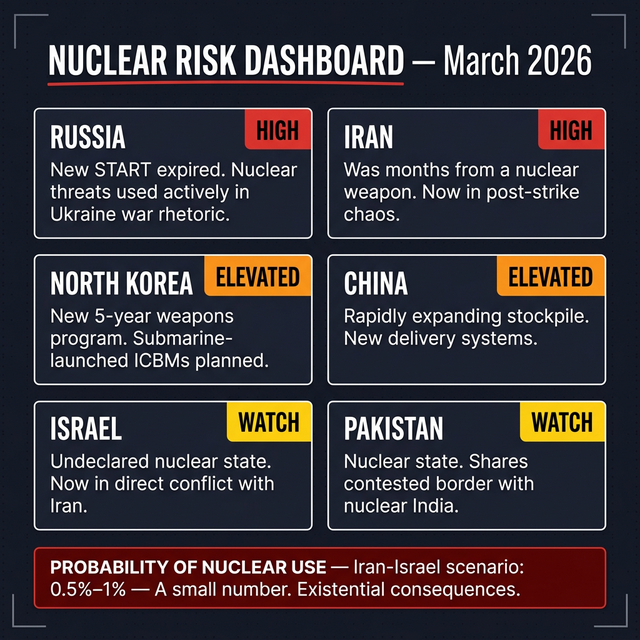
<p>Six nuclear-capable actors are now simultaneously in positions of elevated risk. This combination has never existed before.</p>

<p><strong>Russia:</strong> using nuclear rhetoric throughout the Ukraine war. New START is gone.</p>

<p><strong>China:</strong> rapidly expanding stockpile. On pace to triple warhead count this decade.</p>

<p><strong>North Korea:</strong> new five-year nuclear weapons program. Submarine-launched ICBMs planned.</p>

<p><strong>Iran:</strong> was close to nuclear capability before the strikes. What happens to the program in the chaos is unknown.</p>

<p><strong>Israel:</strong> undeclared nuclear state now in direct, active conflict with Iran.</p>

<p><strong>Pakistan:</strong> nuclear state sharing a contested border with nuclear India.</p>

<blockquote>
  <p>AI models estimate the probability of nuclear use in the current Iran-Israel scenario at between <strong>0.5% and 1%</strong>.
That sounds small. But no number attached to nuclear war is small.</p>
</blockquote>

<p><span class="recap">For the first time in modern history, six nuclear-armed actors are simultaneously in elevated tension, with no arms control treaties limiting any of them.</span></p>

<hr />

<h2 id="part-9">Part 9: Your Wallet in a World at War</h2>

<p align="center">
  <img src="/blogs/assets/posts/geopolitical-world-report-march2026/13-economy-snapshot.png" width="85%" alt="Global Economy Forecast 2026: GDP Growth Comparison" />
</p>

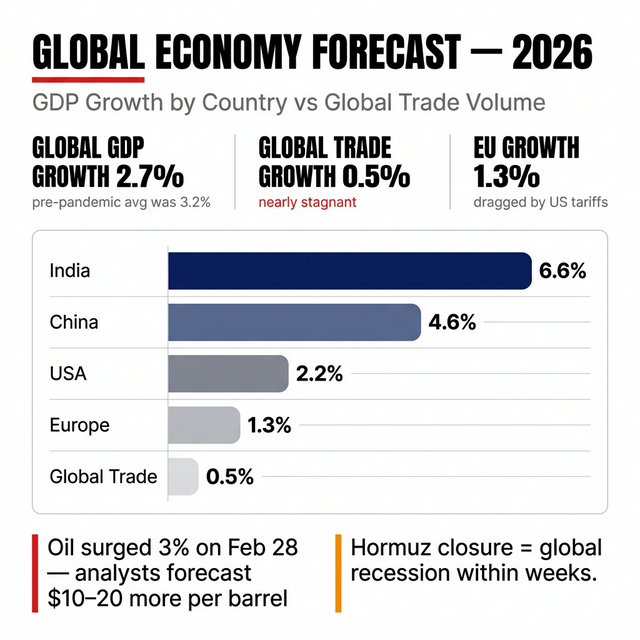
<p>Global GDP growth in 2026 is forecast at <strong>2.7%</strong>, well below the pre-pandemic average of 3.2%. Global trade volume will grow by just <strong>0.5%</strong>, nearly stagnant. The European Union is forecast to grow at only <strong>1.3%</strong>, dragged down by US tariffs and geopolitical uncertainty.</p>

<p>The bright spot is South Asia. India’s economy is growing at <strong>6.6%</strong>, the fastest of any major economy in the world.</p>

<p>But the biggest economic risk right now is not a trade war. It is a 21-mile-wide strip of water.</p>

<hr />

<h3 id="the-strait-of-hormuz-the-worlds-oil-tap">The Strait of Hormuz: The World’s Oil Tap</h3>

<p align="center">
  <img src="/blogs/assets/posts/geopolitical-world-report-march2026/07-strait-of-hormuz.png" width="85%" alt="The Strait of Hormuz: Oil Flow and Global Dependency" />
</p>

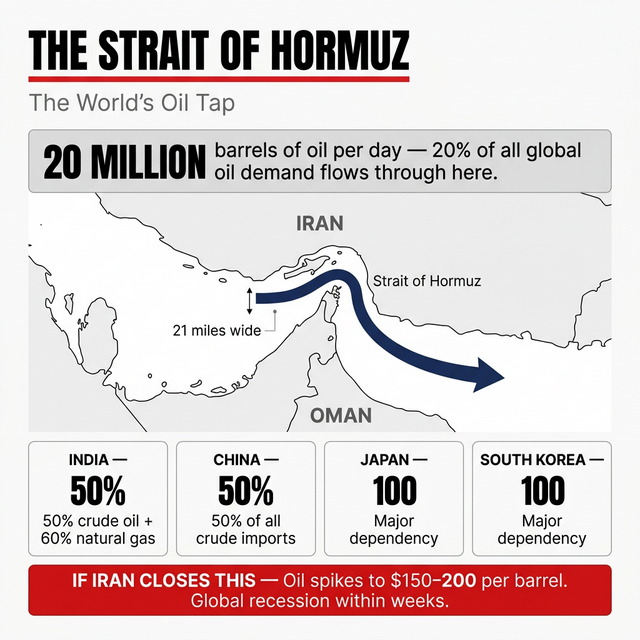
<p>The Strait of Hormuz sits between Iran and Oman. Every single day, <strong>20 million barrels of oil</strong> flow through it: approximately <strong>20% of all global oil demand</strong>.</p>

<p>China receives <strong>50% of its crude oil imports</strong> through Hormuz. India receives <strong>50% of its crude oil and 60% of its natural gas</strong> through the same corridor.</p>

<p>If Iran closes the strait, oil prices could spike from their current level near $72 per barrel to somewhere between <strong>$150 and $200 per barrel</strong>. Global inflation would surge. Fuel shortages would hit Asia within days. A global recession would follow within weeks.</p>

<p>Markets already moved on February 28 alone. Brent crude jumped nearly <strong>3%</strong> in a single session.</p>

<p><span class="recap">One 21-mile strait holds the global economy hostage. If Iran closes the Strait of Hormuz, a worldwide recession follows within weeks.</span></p>

<hr />

<h2 id="part-10">Part 10: What Could Get Worse, and How</h2>

<p align="center">
  <img src="/blogs/assets/posts/geopolitical-world-report-march2026/12-domino-effect.png" width="80%" alt="The Domino Effect: How One Crisis Triggers Everything" />
</p>

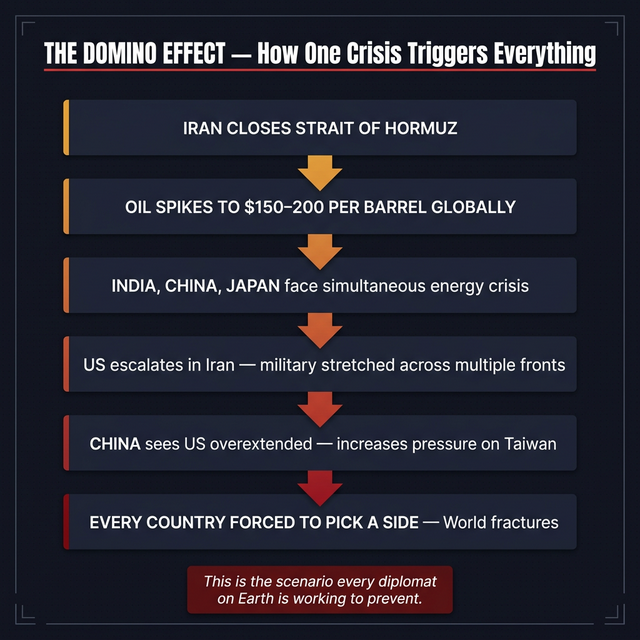
<p>The most dangerous feature of the current moment is not any single crisis. It is how each crisis can feed the others.</p>

<p>If Iran closes the Strait of Hormuz, oil prices spike globally. That hits China hardest, cutting off half its crude supply, which could stall China’s economy and increase domestic political pressure. Increased domestic pressure historically correlates with increased external aggression. The window for Taiwan narrows.</p>

<p>Meanwhile, if the United States is militarily committed in Iran and simultaneously confronting China over Taiwan, Europe is left to handle Ukraine largely alone. Russia would recognize the opportunity.</p>

<p>Each of these is possible. The combination of all of them is the scenario that keeps security analysts awake at night.</p>

<p><span class="recap">The real danger isn’t any single crisis. It’s the feedback loop: each crisis accelerates the others.</span></p>

<hr />

<h2 id="part-11">Part 11: India: The Country Everyone Needs</h2>

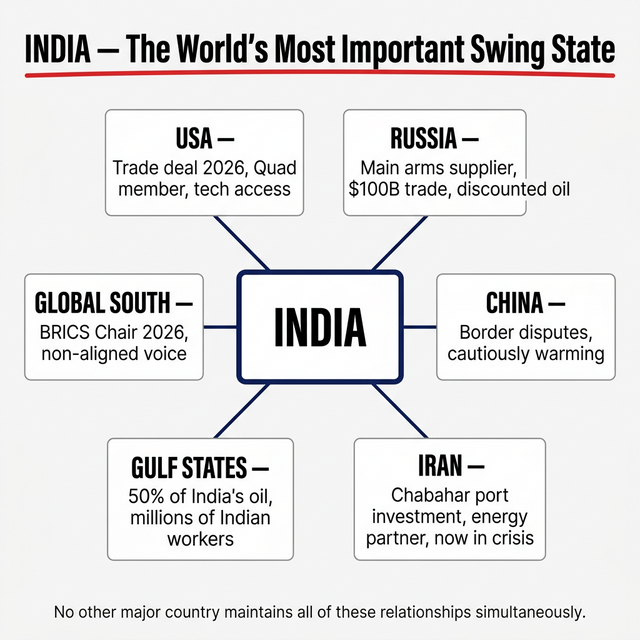
<p align="center">
  <img src="/blogs/assets/posts/geopolitical-world-report-march2026/10-india-hub.png" width="85%" alt="India: The World's Most Important Swing State" />
</p>

<p>In a world fracturing into opposing blocs, India occupies a unique and precarious position. It maintains meaningful relationships with <strong>every major power simultaneously</strong>, and no country in the world can currently say the same.</p>

<p>India is a member of the <strong>Quad</strong> (the US-Japan-Australia security partnership). It is also Russia’s largest arms customer and one of Russia’s most important economic partners. It built the <strong>Chabahar Port</strong> in Iran for Central Asia access. It is slowly normalizing with China. And it holds the <strong>BRICS chairmanship</strong> in 2026, positioning itself as the leading voice of the Global South.</p>

<hr />

<h3 id="indias-official-response-to-the-iran-strike">India’s official response to the Iran strike</h3>

<blockquote>
  <p>India’s Ministry of External Affairs, March 1, 2026:
<em>“India calls for an immediate ceasefire from the United States, Israel, and Iran.”</em></p>
</blockquote>

<p>Classic Indian diplomacy: don’t pick a side, call for peace, stay on talking terms with everyone.</p>

<hr />

<h3 id="indias-three-choices">India’s Three Choices</h3>

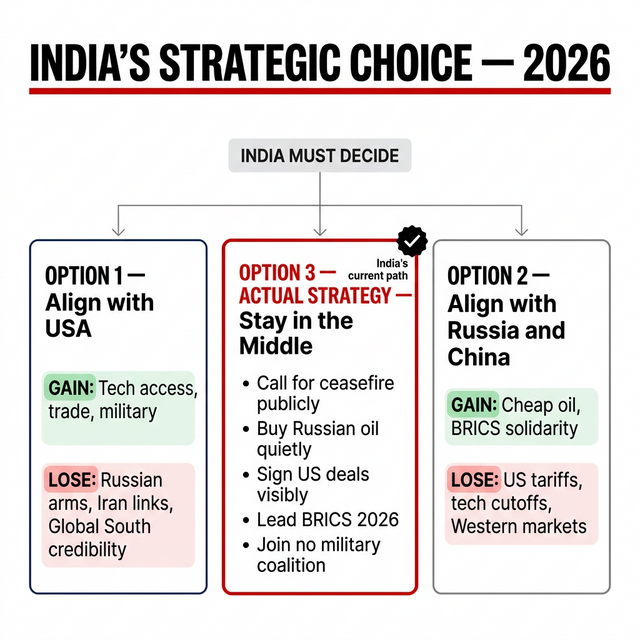
<p align="center">
  <img src="/blogs/assets/posts/geopolitical-world-report-march2026/11-india-options.png" width="85%" alt="India's Three Strategic Options, 2026" />
</p>

<p>India could align fully with the United States. It would gain technology access, stronger trade terms, and military partnership. It would lose Russian arms, its Iran relationships, and its credibility as a Global South leader.</p>

<p>India could align with Russia and China. It would keep cheap oil and BRICS solidarity. It would face US tariffs, technology cutoffs, and isolation from Western markets.</p>

<p>India will do neither. It will stay in the middle, calling for ceasefire everywhere publicly, buy Russian oil quietly, sign US trade deals visibly, lead BRICS, and join no military coalition. It is the strategy India has used since the Cold War.</p>

<p>The question of 2026 is whether the fracturing world will allow that strategy to continue.</p>

<p><span class="recap">India’s non-alignment strategy has worked for decades. The question is whether a fracturing world will still allow it.</span></p>

<hr />

<h2 id="part-12">Part 12: What Happens Next</h2>

<p>Here is an honest assessment of where each situation goes.</p>

<p><strong>Iran</strong> will remain in crisis for months at minimum. An IRGC-dominated interim government is the most likely immediate outcome.</p>

<p><strong>Ukraine</strong> has the best chance of a ceasefire in mid-2026, but only if US diplomatic attention is not entirely consumed by Iran.</p>

<p><strong>Gaza</strong> is likely to see a renewed Israeli military operation if Hamas does not disarm.</p>

<p><strong>Taiwan</strong> will not be invaded in 2026, but gray zone pressure will intensify.</p>

<p><strong>North Korea</strong> will conduct at least one provocative missile or nuclear test. It will not start a full war.</p>

<p><strong>A global recession</strong> is a real possibility if the Strait of Hormuz is disrupted for more than four weeks.</p>

<hr />

<h2 id="five-things-you-need-to-know-about-the-world-right-now">Five Things You Need to Know About the World Right Now</h2>

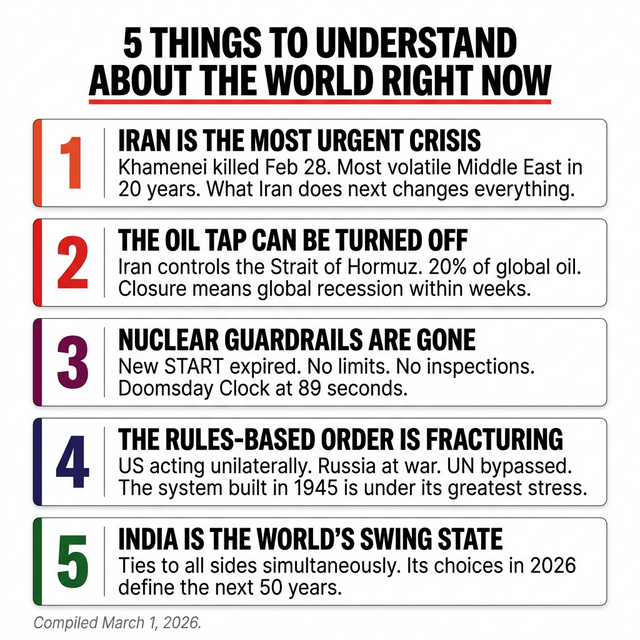
<p align="center">
  <img src="/blogs/assets/posts/geopolitical-world-report-march2026/14-final-summary.png" width="90%" alt="5 Things to Understand About the World Right Now, March 2026" />
</p>

<p><strong>One.</strong> Iran is the most urgent crisis. Khamenei was killed on February 28. The Middle East is more volatile right now than at any point since the 2003 Iraq invasion.</p>

<p><strong>Two.</strong> The world’s oil tap can be turned off. Iran controls the Strait of Hormuz. Twenty percent of global oil passes through it every day. A closure means a global recession within weeks.</p>

<p><strong>Three.</strong> Nuclear guardrails are gone. The last US-Russia arms control treaty expired in February 2026. The Doomsday Clock is at 89 seconds. We are in historically dangerous territory.</p>

<p><strong>Four.</strong> The rules-based world order is fracturing. The United States acted alone in Venezuela and Iran. Russia has been at war with Ukraine for four years. China is pressing Taiwan. The system built after 1945 is under the greatest stress in its history.</p>

<p><strong>Five.</strong> India is the world’s most important swing state. It has lines open to every side simultaneously. Its choices in 2026 will define its role in the emerging world order for the next fifty years.</p>

<hr />

<h2 id="what-to-watch-in-the-coming-months">What to Watch in the Coming Months</h2>

<table>
  <thead>
    <tr>
      <th>Date</th>
      <th>Event</th>
    </tr>
  </thead>
  <tbody>
    <tr>
      <td><strong>March 2026</strong></td>
      <td>China’s annual legislative session, next five-year plan approved</td>
    </tr>
    <tr>
      <td><strong>March 2026</strong></td>
      <td>Russia-Ukraine Geneva talks (if not derailed by Iran crisis)</td>
    </tr>
    <tr>
      <td><strong>Mid 2026</strong></td>
      <td>Most likely window for a Ukraine ceasefire</td>
    </tr>
    <tr>
      <td><strong>July 2026</strong></td>
      <td>NATO Ankara Summit, defense spending and Ukraine security</td>
    </tr>
    <tr>
      <td><strong>2026</strong></td>
      <td>BRICS Summit under India’s chairmanship</td>
    </tr>
    <tr>
      <td><strong>2027</strong></td>
      <td>China’s declared military readiness target year, the year analysts watch for Taiwan</td>
    </tr>
  </tbody>
</table>

<hr />

<h2 id="sources">Sources</h2>

<ul>
  <li><a href="https://www.npr.org/2026/02/28/nx-s1-5730158/israel-iran-strikes-trump-us">NPR: Khamenei Killed</a></li>
  <li><a href="https://www.aljazeera.com/news/liveblog/2026/2/28/live-israel-launches-attacks-on-iran-multiple-explosions-heard-in-tehran">Al Jazeera: Iran Confirms Khamenei Killing</a></li>
  <li><a href="https://en.wikipedia.org/wiki/2026_Israeli%E2%80%93United_States_strikes_on_Iran">Wikipedia: 2026 US-Israel Strikes on Iran</a></li>
  <li><a href="https://www.pbs.org/newshour/world/live-updates-u-s-and-israel-attack-on-iran">PBS News: Live Updates</a></li>
  <li><a href="https://www.cnbc.com/2026/02/28/markets-brace-for-impact-following-us-military-strikes-against-iran.html">CNBC: Markets Brace for Impact</a></li>
  <li><a href="https://www.businesstoday.in/latest/economy/story/us-israel-strike-on-iran-attack-puts-50-of-indias-oil-imports-at-risk-via-hormuz-518462-2026-02-28">BusinessToday India: 50% of India’s Oil at Risk</a></li>
  <li><a href="https://www.stimson.org/2026/iran-after-khamenei-recalibration-or-retrenchment/">Stimson Center: Iran After Khamenei</a></li>
  <li><a href="https://www.chathamhouse.org/2026/01/lines-between-indias-foreign-policy-domestic-politics-and-economy-will-become-increasingly">Chatham House: India 2026</a></li>
  <li><a href="https://www.cfr.org/report/conflicts-watch-2026">CFR: Conflicts to Watch 2026</a></li>
  <li><a href="https://www.crisisgroup.org/cmt/global/10-conflicts-watch-2026">Crisis Group: 10 Conflicts to Watch 2026</a></li>
  <li><a href="https://www.stimson.org/2026/top-ten-global-risks-for-2026/">Stimson Center: Top 10 Global Risks 2026</a></li>
  <li><a href="https://chinapower.csis.org/survey-experts-us-china-relations-2026/">CSIS: US-China Expert Survey 2026</a></li>
  <li><a href="https://foreignpolicy.com/2026/01/02/top-10-risks-2026-ukraine-trump/">Foreign Policy: Top 10 Risks 2026</a></li>
  <li><a href="https://www.aljazeera.com/news/2026/2/22/iran-us-tensions-what-would-blocking-strait-of-hormuz-mean-for-oil-lng">Al Jazeera: Hormuz Explainer</a></li>
  <li><a href="https://finance.yahoo.com/news/us-strikes-against-iran-could-see-oil-prices-jump-10-to-20-or-more-with-no-deescalation-143847017.html">Yahoo Finance: Oil Could Jump $10-$20</a></li>
  <li><a href="https://icds.ee/en/indias-strategic-recalibration-managing-us-volatility-and-chinas-opportunism/">ICDS: India’s Strategic Recalibration</a></li>
  <li><a href="https://press.un.org/en/2026/sc16300.doc.htm">UN News: Sudan Year 4</a></li>
</ul>

<hr />

<table>
  <tbody>
    <tr>
      <td>*Compiled: March 1, 2026</td>
      <td>For educational and informational purposes</td>
      <td>Predictions are analytical assessments, not certainties.*</td>
    </tr>
  </tbody>
</table>]]></content><author><name>Nikhil Rao</name></author><category term="geopolitics" /><category term="iran" /><category term="ukraine" /><category term="india" /><category term="nuclear" /><category term="china" /><category term="middle-east" /><summary type="html"><![CDATA[A plain-English briefing on every major crisis happening right now. March 1, 2026.]]></summary><media:thumbnail xmlns:media="http://search.yahoo.com/mrss/" url="https://breeznik.github.io/blogs/assets/posts/geopolitical-world-report-march2026/01-hero.png" /><media:content medium="image" url="https://breeznik.github.io/blogs/assets/posts/geopolitical-world-report-march2026/01-hero.png" xmlns:media="http://search.yahoo.com/mrss/" /></entry></feed>